


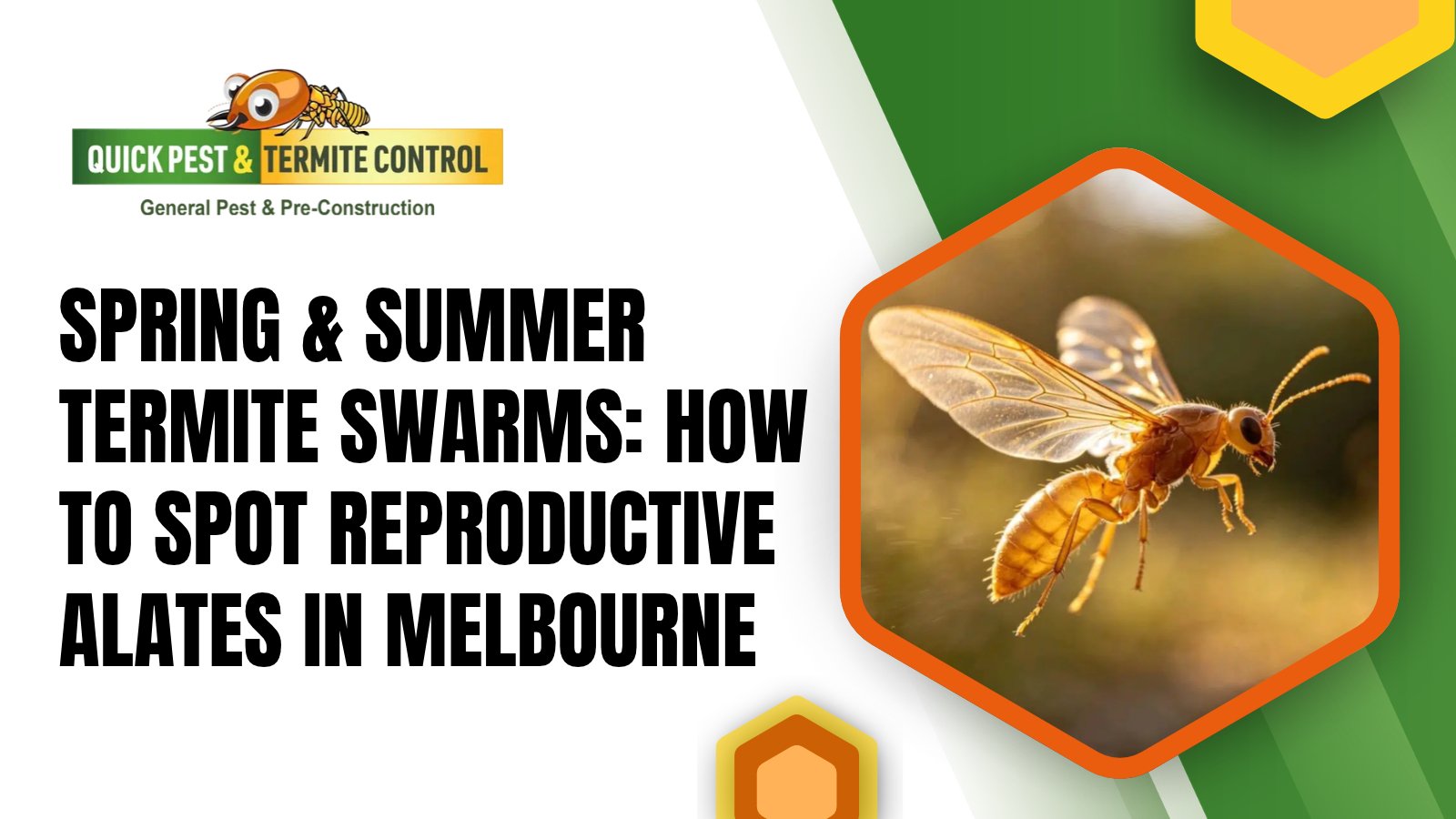
Spotting winged insects around your windows or porch lights during warm, humid Melbourne weather often signals a Termite Swarm. Do not spray them with household fly spray—collect a few samples and book Termite Inspections Melbourne immediately to check for hidden colony activity.
Every year between late spring and summer, Melbourne homeowners notice sudden bursts of flying insects gathering near outdoor lights, window frames, and doorways. While many people assume these are harmless flying ants, they are often Reproductive Alates—winged termites leaving an established nest to start new colonies.
Because termites work silently behind plasterboard and under timber floors, a swarm is often the very first visible warning sign that a mature nest is nearby—or already inside your property.
Why Do Termites Swarm in Spring and Summer?
A termite colony spends years growing underground before it produces winged Reproductive Alates. Once the nest reaches maturity, warm temperatures paired with high humidity—especially right after a spring or summer rainstorm—trigger thousands of these winged termites to take flight at the same time.
Their sole purpose is to pair up, shed their wings, and burrow into damp soil or timber to start a brand-new nest. If you find piles of discarded, clear wings on your windowsills, deck, or bathroom floor, a swarm has likely happened inside or right next to your home.
Flying Termites vs. Flying Ants: How to Tell Them Apart
Flying ants also swarm in warm weather, and they look very similar at first glance. Checking three simple body features will help you tell them apart without needing a magnifying glass.
- The Waist: Flying Termites have a thick, straight waist with no pinch in the middle. Flying Ants have a narrow, pinched waist like a standard garden ant.
- The Wings: Flying Termites have two pairs of wings that are equal in length and much longer than their bodies. Flying Ants have front wings that are noticeably longer than their back wings.
- The Antennae: Flying Termites have straight, bead-like antennae. Flying Ants have bent or elbowed antennae.
If the insects have straight waists, equal-length wings, and straight antennae, you are dealing with termites and need prompt Termite Pest Control Melbourne support.
Why Store-Bought Bug Sprays Make Termite Problems Worse
When homeowners see winged termites crawling out of a wall crack or skirting board, the natural instinct is to grab a can of supermarket surface spray. Unfortunately, spraying visible termites is one of the worst things you can do.
Household sprays only kill the few dozen insects you can see on the surface. The remaining hundreds of thousands of workers hidden inside your wall framing sense the chemical disturbance, seal off that mud tunnel, and quietly shift their feeding to another part of your home.
Even worse, disturbing active termites makes it harder for a technician to trace their entry point and apply effective Termite Treatment Melbourne solutions that wipe out the entire nest.
DIY Bug Spray vs. Professional Termite Inspection
Understanding what happens behind your walls makes it clear why a proper check beats guesswork every time.
| Stage | DIY Supermarket Spray | Professional Termite Inspection |
| 1. Initial Response | Sprays only the winged insects visible on windowsills or skirting boards. | Inspects interior timbers, roof voids, subfloors, fences, and garden beds. |
| 2. Hidden Detection | Relies purely on eyesight, missing active mud leads inside walls. | Uses thermal cameras and radar sensors to detect activity behind plaster. |
| 3. Colony Impact | Scares foraging termites deeper into structural timber without killing the queen. | Identifies the exact species and maps entry points for targeted colony elimination. |
| 4. Long-Term Safety | Leaves the property unprotected against future swarms and hidden damage. | Recommends tailored protection to keep the home safe year-round. |
How Modern Inspections Find Hidden Termites Without Damaging Walls
Today’s Professional Termite Inspections Melbourne homeowners rely on go far beyond tapping skirting boards with a torch. Experienced technicians follow strict Australian Standards (AS 4349.3) to check every accessible area of your property—from the roof void and internal walls down to the subfloor, garden sleepers, and fence lines.
To check behind plasterboard and brickwork without drilling holes, we use two non-invasive tools:
- Thermal Imaging Cameras: Termite nests and moisture-heavy mud tunnels generate subtle temperature differences inside walls. A thermal camera highlights cold or warm spots behind surfaces that look completely normal to the naked eye.
- Termatrac Radar: This motion-sensing radar sends harmless signals through timber, plaster, and brick to detect tiny movements of termites chewing or travelling inside your walls.
Booking regular Termite Inspections Melbourne ensures early detection before minor mud leads turn into costly structural repairs.
Why Northern Melbourne Suburbs Face High Seasonal Swarm Risk
Across Melbourne’s rapidly growing northern corridor, local soil and construction styles create ideal conditions for subterranean termites to thrive.
Pest Control Craigieburn
Many established and newer homes in Craigieburn sit on reactive clay soils that hold moisture deep underground after spring rain. Combined with landscaped garden beds built close to external brick walls, termites have easy access to concealed entry points.
Pest Control Wollert
Wollert’s ongoing residential development disturbs natural underground termite habitats, pushing displaced colonies toward nearby concrete-slab homes. Even newer builds need ongoing monitoring once garden mulch, irrigation systems, and timber retaining walls are added around the perimeter.
Pest Control Mickleham
Properties in Mickleham often border open grasslands and timber fencing where subterranean colonies nest in old tree roots. Warm afternoon winds frequently carry swarming alates straight onto neighbouring patios, eaves, and pergolas.
Long-Term Ways to Protect Your Home After an Inspection
Once an inspection confirms whether termites are active on your property, your technician will walk you through practical protection options suited to your home’s construction:
- Targeted Colony Elimination: If active termites are found, installing Termite Baiting Systems allows foraging workers to carry a slow-acting bait back to the nest, eliminating the entire colony—including the queen.
- Continuous Soil Protection: Applying Chemical Barriers for Termite Protection around the external perimeter creates an undetectable treated zone in the soil so termites cannot cross into your foundations.
- Protection for New Builds and Extensions: If you are renovating or building a new home, installing Pre-Construction Termite Barriers protects slab penetrations and perimeter joints right from day one.
- Maintaining Existing Systems: Older homes with under-slab or perimeter piping should schedule Termite Reticulation Refill Services Melbourne on time so the protective chemical zone stays active.
Frequently Asked Questions
What should I do if I find flying termites inside my house?
Keep calm and avoid spraying them with household insecticides. Gently sweep a few intact insects or discarded wings into a sealed jar or zip-lock bag so your technician can confirm the species, and arrange a professional inspection straight away.
Do flying termites eat wood themselves?
No, winged reproductive alates do not eat timber. However, their presence proves that a mature, wood-eating worker colony is living close by—or already feeding inside your home’s timber framing.
How often should Melbourne homes have a termite inspection?
Australian Standards recommend a thorough timber pest inspection at least once every 12 months, or every 6 months if your property sits in a high-risk area near bushland, creeks, or reactive clay soils.
Book a Termite Inspection in Melbourne Today
If you have spotted winged insects around your lights, found discarded wings near windows, or simply want peace of mind before summer heat peaks, Quick Pest & Termite Control is ready to help. Operating out of Upper Plenty and servicing homes across northern Melbourne, our licensed technicians provide thorough, honest assessments with clear advice.
Call us directly on 0474 704 396, email info@quicktermite.com , or submit an online enquiry during our operating hours (Monday–Saturday, 7:00 AM – 5:00 PM) to protect your property before small signs turn into major damage.


